What Hendersonville's Median Home Price Doesn't Tell You
September 3, 2026
September 3, 2026
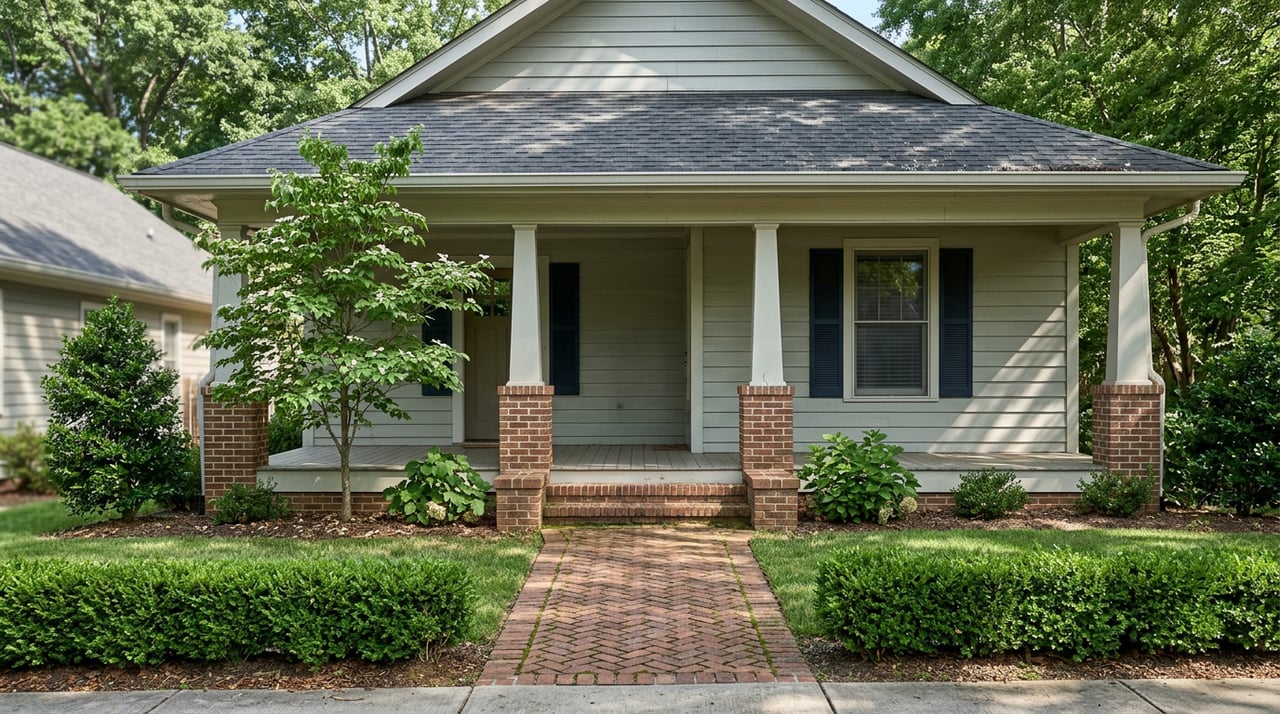
A buyer touring Hendersonville on a Saturday morning might start in Hyman Heights, walking through a 1920s Craftsman bungalow with heart pine floors and a wraparound porch, five minutes from Main Street. By afternoon, the same buyer is touring a one-level brick home on a wooded acre inside Kenmure's gated entrance in Flat Rock, golf cart parked in the driveway, mountain views out the back windows. Both homes are listed within a few thousand dollars of each other. On paper, the buyer is comparing two houses at roughly the same price.
They are not comparing the same thing at all.
The number that shows up in every portal search, the citywide median, treats these two homes as interchangeable data points. It isn't wrong, exactly. It just hides the part of the decision that actually matters once you own the place: what governs what you're allowed to do to it, and what you're committed to paying every month whether you use it or not.
In March 2026, homes sold in Hendersonville for a median of $409,000, working out to roughly $231 per square foot, according to Redfin. By August 2026, homes listed for sale carried a median asking price closer to $500,000, or about $260 per square foot, per Movoto's tracking.
That's not a market swinging wildly in five months. It's two different measurements. One is what buyers actually paid when a deal closed in March. The other is what sellers are asking, as of the peak late-summer listing season, before any negotiation happens. The gap between them is a reminder that a headline median tells you almost nothing about a specific house until you know where in the city that house sits and what kind of ownership comes attached to it.
That's the real question underneath the number: what does this price buy, and what does it obligate you to?
Druid Hills, Hyman Heights (formally listed with the adjoining Mount Royal section), and Lenox Park are Hendersonville's three walkable historic residential districts, all administered by the city's Historic Preservation Commission. Each has its own story. Druid Hills was platted in 1923 with curvilinear, tree-lined streets in the Olmstedian style and counts 76 contributing structures, mostly Craftsman Bungalow, Tudor Revival, and Colonial Revival homes. Hyman Heights was platted in 1908 and grew up around Patton Hospital, which opened on Highland Avenue in 1913. Physicians built homes there in the same styles, and the district's oldest structure, the Gothic Revival "Killarney" house, dates to 1858. It counts 123 contributing structures, the largest of the three. Lenox Park traces back to the 1908 Columbia Park subdivision and today holds the town's largest intact grouping of turn-of-the-century Queen Anne, Foursquare, and gable-front homes.
Buying in one of these districts means most exterior work on the house, from a new roofline to replacement windows to a fence along the street, needs a Certificate of Appropriateness from the city before work starts. Interior renovations are generally outside that process entirely. Kitchens, bathrooms, and mechanical systems can be updated without design review in most cases. What triggers review is anything visible from the street: siding, masonry, window replacement, additions, new construction, and demolition or relocation of any part of the structure.
The city's own guidance splits this into major and minor work. Minor projects, like a fence built from approved materials, screened HVAC equipment, or masonry repairs that match the original mortar and brick, can be approved at the staff level without going before the full Commission. Major work, such as an addition or new construction, goes through a formal review. Neither path costs a recurring monthly fee. Both add a timeline you need to plan around before you sign a contractor.
Four miles south of downtown Hendersonville in Flat Rock, Kenmure sits on 1,400 gated acres, with roughly 700 of a planned 900 homes built since development began in the mid-1980s. One detail sets it apart from a lot of mountain communities in the region: water, sewer, and natural gas come from the City of Hendersonville rather than private wells and septic systems, which is worth knowing if you've shopped other gated communities in Western North Carolina where those utilities are handled in-house.
The centerpiece is an 11,000-square-foot clubhouse built from a mid-1800s mansion, overlooking a Joe Lee-designed 18-hole course. HOA dues, which cover road maintenance, trash collection, and 24-hour gated security, run in the range of roughly $90 to $130 a month depending on the property and the source you check. Lot sizes range from about a third of an acre up to 4.5 acres, and homes here have been reported with a median sale price well above the citywide figure.
Here's the part that doesn't show up in a listing photo: HOA dues are mandatory, but joining the country club itself is optional. If you want access to the golf course, the pools, the fitness center, and the dining room in that mansion, that membership carries its own initiation fee and its own monthly dues, stacked on top of the HOA. Nearby communities like Champion Hills and Cummings Cove follow a similar structure: a base HOA that everyone pays, and a separate golf membership tier for residents who actually want to use the course.
None of this is disclosed in a way that changes the list price. It changes what the price costs you every month for as long as you own the house.
Here's the comparison side by side.
| Historic in-town bungalow (Druid Hills, Hyman Heights, Lenox Park) | Gated golf community (Kenmure) | |
|---|---|---|
| Distance from Main Street | Roughly a 5 to 15 minute walk | About 4 miles, under 10 minutes by car |
| Typical lot size | Quarter acre or smaller, uniform setbacks | A third of an acre up to 4.5 acres |
| What governs changes | Certificate of Appropriateness from the Historic Preservation Commission for most exterior work | HOA covenants, plus an optional country club membership |
| Recurring cost beyond taxes and insurance | None required, though major exterior work adds a design review timeline | HOA dues in the range of $90 to $130 a month, plus an optional club initiation fee and monthly dues |
| Home style era | Craftsman Bungalow, Tudor Revival, Colonial Revival, Queen Anne, Foursquare, mostly 1900s to 1930s | Contemporary and traditional builds from the mid-1980s forward |
Two houses at the same price point are asking you to accept two different kinds of friction. The historic bungalow asks you to accept a review board's opinion on your porch railings and window trim before you can change them, in exchange for no mandatory monthly bill tied to the neighborhood itself. The golf-community home asks you to accept a fixed monthly cost, whether or not you golf, in exchange for skipping that design review entirely and getting amenities the in-town house doesn't have.
Neither is a better deal in the abstract. One is a regulatory cost paid in time and paperwork. The other is a financial cost paid in dollars every month. The identical median price on a listing sheet is doing a lot of work to make these look like the same decision when they aren't.
If you're the kind of buyer who wants to restore original woodwork, plant a garden, and never think about a homeowners association again, the historic districts reward patience with paperwork more than patience with a checkbook. Budget time for a Certificate of Appropriateness on any exterior project, and talk to the city's Planning Division before you assume a renovation is straightforward.
If you're the kind of buyer who wants gated privacy, a golf cart in the garage, and amenities without personally maintaining a clubhouse, the HOA and optional club fees are the price of that convenience, and they're worth running through your monthly budget the same way you'd run a mortgage payment, because they don't go away once the loan is paid off.
Either way, the citywide median is a starting point for a conversation, not the answer to it. What a specific house in a specific Hendersonville neighborhood actually costs you, this year and every year after, depends on which of these two systems it sits inside.
Do I have to join the country club if I buy in Kenmure? No. HOA dues are mandatory for every property owner and cover the gated community's roads, trash service, and security. Golf, pool, tennis, and dining access at the clubhouse come through a separate membership that you can choose to join or skip.
Can I renovate the inside of a historic Hendersonville home however I want? Generally, yes. The Certificate of Appropriateness process is focused on exterior changes and site features visible from the street. Interior work like kitchens, bathrooms, and mechanical upgrades typically falls outside that review.
Which option costs less over time? It depends entirely on what kind of owner you are. A historic home with no major exterior plans may cost you nothing extra for years. A golf-community home with mandatory HOA dues costs something every single month regardless of your renovation plans. Run both scenarios against your own budget and your own tolerance for design review before assuming either one is the cheaper path.
If you're weighing a historic bungalow against a golf-community home and want to talk through what each one actually commits you to, The Amy Team knows both sides of Hendersonville well enough to walk you through the fine print before you fall in love with a porch or a fairway view. Schedule Your Free Home Valuation and let's figure out which kind of Hendersonville home actually fits how you want to live.
Stay up to date on the latest real estate trends.
Our approach is grounded in the core values of hard work, integrity, and delivering exceptional client service. We are dedicated to providing a seamless and positive experience throughout the entire process.